
Federal BOP Release Paths
The Federal Bureau of Prisons administers sentenced federal imprisonment. People arrested on federal charges are commonly managed by USMS through court and disposition, sometimes in contract beds. BOP becomes the main public locator after commitment to a federal sentence. No BOP prison was identified as a physical Okmulgee County facility. The system belongs in the county map because a local or Moore custody trail can lead into federal sentenced custody.
Leaving BOP can mean sentence completion, transfer out of BOP responsibility, or another status reflected by the federal record. A former prisoner may begin a term of supervised release ordered by the federal court. That supervision is not BOP prison custody, yet it remains part of the sentence. A detainer can also lead to another custodian after BOP’s event ends.
Confirm a Federal BOP Release
Use the official BOP Inmate Locator. An agency number is the strongest search key. BOP accepts a BOP Register number, DCDC number, FBI number, or INS number. A name search can be narrowed by race, sex, and age. Compare each returned identifier before choosing a match.
- Enter the known federal number, or use the full legal name and available filters.
- Open or read the matching result and save the register number.
- Record the exact location or status wording and displayed release date.
- Check the federal docket and judgment for the sentence and supervised-release term.
- If another custodian is indicated, confirm that agency separately.
BOP’s locator covers federal incarceration records from 1982 to the present. Older records require an archival route described by the agency. The search does not cover a person held only by USMS before BOP commitment. For a federal trail that began in local detention, the Okmulgee County release-record search can establish the first transfer, and BOP can establish the later sentenced-custody status.
Federal BOP Release Fields
The locator result includes a compact set of public fields. They help match a person and understand the BOP event, but they are not a complete sentencing or release file. The federal court docket supplies the legal case history.
| BOP field | What it supports |
|---|---|
| Name | The identity reported in the federal locator |
| Register number | The best BOP-specific record key |
| Age, race, and sex | Filters and match checks |
| Release date | The date reported for the BOP custody event |
| Location or status | Current institution or released/not-in-custody wording |
“Not in BOP Custody” is system-specific. It does not explain whether the person is with USMS, ICE, a state agency, or in the community. Likewise, “Released” does not state whether federal supervised release began. Use the judgment and probation-related docket entries to answer that question.
Federal BOP Release Records
BOP’s locator records explanation defines the scope and limits of the public data. For a deeper record, identify the exact document and use the federal records route appropriate to it. A sentence computation, institution record, judgment, and supervision record come from different custodians.
Federal Bureau of Prisons
BOP Inmate Locator
Search by federal identifier or name
Coverage: 1982 to present in the public locator
No Okmulgee County BOP institution was verified
For the legal basis, retrieve the federal judgment from the court case. It states the term of imprisonment and any supervised release ordered by the court. Later docket entries may show modifications, revocation proceedings, or other orders. A locator date should not be expanded into a claim about the terms of community supervision.
Note: Save the BOP register number because it distinguishes the federal prison record from a local booking number.
Okmulgee Federal Custody Sequence
A federal custody trail can span several bodies. An arrest may lead to USMS responsibility. The person can be placed in a contracted local bed, appear in federal court, and later move to a BOP institution after commitment. Moore Detention Center’s 2021 ICE inspection historically documented USMS use, which makes that route locally relevant. It does not prove that a named prisoner currently followed it.
The sequence is best read as a chain: federal arrest, USMS custody, court disposition, BOP commitment if sentenced to prison, BOP release, then supervised release if ordered. An immigration or state detainer can add another handoff. Each link should have its own source.
- Commitment
- The legal and administrative move into the federal sentence.
- USMS custody
- Federal prisoner management around arrest, court, transport, and disposition.
- BOP custody
- Federal sentenced imprisonment.
- Supervised release
- A court-ordered community term that commonly follows federal imprisonment.
- Detainer
- A hold or request that can cause transfer when one custody term ends.
Federal BOP Locator Source
The successful manifest image below is matched to the federal system. It shows the BOP locator start and the released or not-in-BOP-custody context. Visit the live BOP locator for current data and search labels.
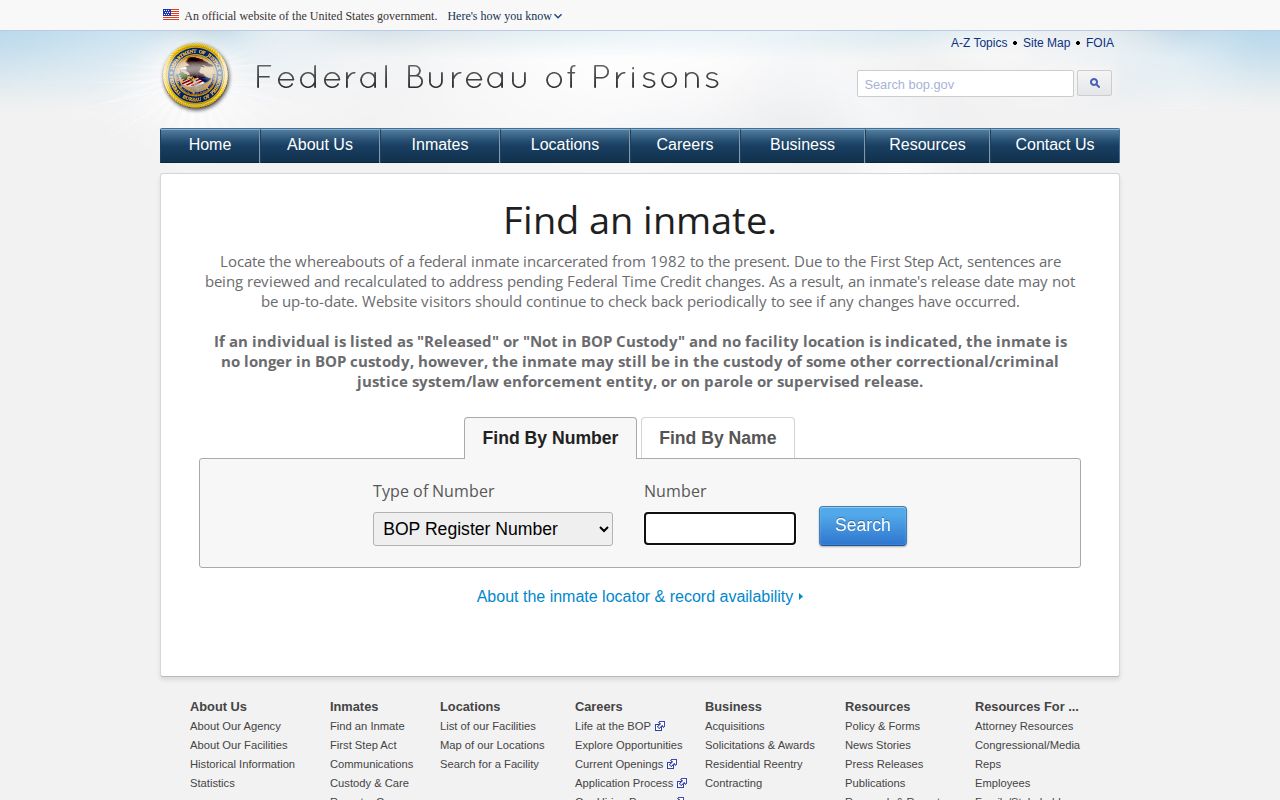
The locator can verify the BOP relationship. It cannot substitute for the federal court’s judgment or prove the absence of another agency’s hold.
When the result is unclear, check the number format. A local OCCJA booking number is not a BOP register number. An ICE A-number can sometimes be used through the locator’s INS-number search, but the ICE system still answers current immigration custody. Keep the systems separate even when an identifier appears in more than one context.
Federal Release Source Comparison
The correct federal source depends on the stage. A common error is searching BOP for someone who remains in USMS pretrial custody. Another is treating a BOP exit as the end of federal supervision. Identify the stage first.
| Question | Primary source | Limit |
|---|---|---|
| Federal pretrial or transport custody? | Federal docket and USMS role | No USMS public release archive |
| Current or former sentenced custody? | BOP locator | Only the BOP relationship |
| Sentence and supervised release? | Federal judgment and docket | May not show physical exit time |
| Local contract-bed exit? | OCCJA record | Must follow the receiving agency |
| Immigration custody after federal exit? | ICE ODLS and case channel | Not a historical release ledger |
Write down the date and exact status from each source. If the records conflict, ask the agency that created the disputed entry. A two-source result, BOP plus the federal case, is stronger than a locator line read alone.
Okmulgee Federal Release Facilities
OCCJA, not BOP, operates Okmulgee County's two local detention facilities. The authority reports combined capacity above 500 and describes Moore as established in 2018. A federal inspection dates Moore's opening to June 2017 and documents federal use. The date difference may reflect separate milestones and should stay attributed.
That history explains why local placement is not the same as BOP imprisonment. A federal prisoner can occupy a contract bed under USMS responsibility before any BOP commitment. Search BOP only when the sentenced-custody stage applies, and use OCCJA plus the federal case for the earlier local exit.
Federal BOP Identity Matching
A federal locator match should rest on more than a shared name. The register number is the best BOP key. Age, race, and sex help narrow name results, while the federal case can connect the person to a judgment. Record the exact name format because suffixes, aliases, and spelling differences can affect the search.
BOP also accepts DCDC, FBI, and INS numbers. Label the number by type. An INS number entered in BOP is still being used to find a BOP record; it does not turn the result into proof of current ICE status. Likewise, an OCCJA control number belongs to the local detention record and should not be placed in a federal locator field.
If BOP returns no match, first decide whether the person ever reached sentenced custody. Someone managed through the USMS prisoner system before trial may not have a BOP entry. Check the federal docket for commitment and transfer events before interpreting the absence.
Federal Release Date Evidence
The displayed BOP release date is stronger than a general roster absence, yet its scope remains narrow. Preserve the exact status, date, register number, and search date. Then read the federal judgment for the prison term and any supervised release. Later docket entries can show a modification or revocation that changes the legal picture.
BOP explains that locator coverage begins in 1982. For older federal imprisonment, follow the archival records path rather than assuming no record exists. The public locator's historical range is a system limit, not a conclusion about the person.
A release date can also precede a handoff. State, local, or immigration custody may begin after BOP. Confirm any detainer or destination shown in the prison or case record. The careful conclusion is “released from BOP on the reported date,” followed by the verified next status, if one exists.