
Okmulgee VINELink Custody Coverage
Oklahoma VINE is the state’s confidential, computer-assisted custody information and notification service. It is accessed through VINELink’s Oklahoma entry, the app, or the state status line. The Attorney General describes anonymous status checks and continuous service. Offered channels include phone, email, text, app, and TTY. Language support is also described, but those service features do not establish that every Oklahoma jail or every ODOC unit submits the same events.
No published agency-by-agency list or captured live Okmulgee match established universal local coverage. Therefore, the safe method is to search the person and inspect the reporting agency on the actual result. If OCCJA is the source, the event concerns that county detention record. If ODOC reports it, the event concerns state corrections. VINE does not become a county release certificate or a complete ODOC sentence history merely because either source participates.
County jail, state prison, federal criminal, and immigration custody remain distinct. VINE is not the BOP Inmate Locator, ICE Online Detainee Locator, or a U.S. Marshals release archive. Someone may leave one source through transfer and remain in another agency’s custody.
Search Okmulgee Inmates on VINELink
A name-only match can point to the wrong person. Start with a full name and an identifying number when one is known. Compare every identifier the live match exposes, including the reporting agency. A person recently held by OCCJA may have a county booking record, while a state prisoner may have an ODOC number. Do not merge those identifiers or assume the same event appears in both systems.
- Open VINELink and select Oklahoma as the state site.
- Choose the custody or offender search offered by the live interface.
- Enter the full name or identifying number. Use the most exact data available.
- Review possible matches and compare identifiers. Reject a match that conflicts with known facts.
- Open the record and read the exact custody status and reporting agency.
- Record the wording, agency, and time checked before contacting that agency for confirmation.
If no match appears, state only that the person was not located in VINELink at that time. The event may predate the searchable data, use another spelling, come from a nonparticipating source, or belong to another custody system. For a known Okmulgee booking, the county release search and records route adds Tiger, OCCJA, and the correct court rather than treating a VINE miss as proof of release.
Note: A VINELink no-result is a source-specific outcome, not proof that a person has left all local, state, or federal custody.
Okmulgee VINELink Release Fields
The researched specific-person interface supports two core fields: custody status and reporting agency, when a participating source returns a match. The exact words matter. A released result means that the reporting source sent that event or status. It should not be paraphrased as “free,” because the person could have transferred, begun supervision, or moved under another hold. The state overview confirms notification actions but does not promise one fixed field set for every source.
| Field or action | What it establishes |
|---|---|
| Custody status | The status reported by the participating source at the time shown |
| Reporting agency | The custodian or source whose relationship the result describes |
| Name or identifier | A basis for comparing the match with known identity facts |
| Event wording | The precise change reported, which may include release or transfer |
| Notification option | An offered way to register for later source events |
The successful manifest capture comes from the official Oklahoma VINELink search start.
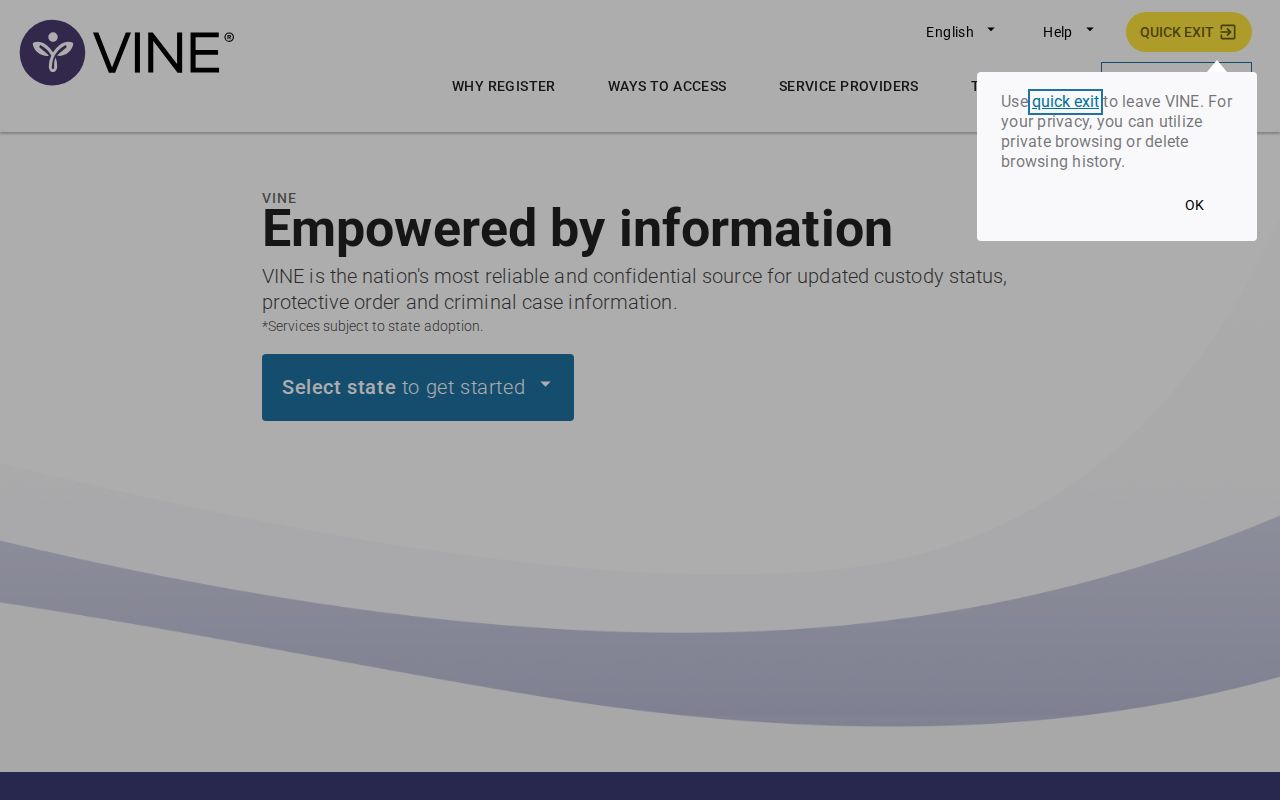
The interface image helps locate the Oklahoma search and notification route, but a person-specific result still must be matched and read live.
Register Okmulgee VINELink Release Alerts
Notification registration starts from the correct match. Oklahoma describes phone, email, text, app, and TTY channels, though the live record controls which options are offered for that source and event. Protect registration details. A phone PIN ordinarily acknowledges an automated call, but the research does not support a claim that all delivery methods use one fixed PIN sequence. Follow the labels displayed during registration.
- Open the verified person match and select the available notification action.
- Choose one or more delivery channels offered by the current interface.
- Enter the phone number, email address, app destination, or TTY information requested.
- Create or enter the PIN or confirmation requested by the live prompt.
- Complete the displayed verification and keep the registration information in a secure place.
- When an alert arrives, save the agency, event text, and timestamp before verifying it.
The Oklahoma VINE status and registration line is 1-877-654-8463. It is an alternative to the web interface and can support an anonymous status check. The Attorney General’s OK VINE overview is the official source for channels and service features.
Note: Current screen labels control registration, since phone, text, email, app, and TTY prompts do not necessarily share one confirmation flow.
Confirm Okmulgee VINELink Release Events
An alert is contemporaneous evidence from its reporting source, not a universal clearance check. For an OCCJA event, call the detention authority and ask for the actual release time, authority or type, and destination or receiving agency. OCCJA operates the local detention facilities even though the Sheriff links visitors to inmate information. A person leaving the local roster can enter ODOC, another county, tribal or federal custody, or an immigration process.
For an ODOC event, compare the official offender lookup and contact Offender Records or Sentence Administration when an exact discharge matters. Parole is physical prison release under continuing supervision, not discharge. A PPB alert or notice can concern a hearing rather than the gate event. Read the event label before deciding which office to call.
Federal sentenced custody belongs in the BOP locator. Federal pretrial or transport custody may follow the federal case and U.S. Marshals channels. ICE ODLS covers present immigration detention, not a historical release ledger. None of those routes should be replaced by an Oklahoma VINE search.
Okmulgee Registry Notifications Differ
Oklahoma’s Sex Offender Registry and Mary Rippy Violent Crime Offenders Registry are limited to people with duties under their governing statutes. They are not released-inmate lists. Registry presence establishes a registration record, not a jail exit time, sentence discharge, or absence from all custody. Their ongoing notices also differ from a VINE custody-event alert.
If registry information conflicts with an official status, use the correction route on the person’s registry detail, including the documented “submit a note” option. Do not infer that all released people appear in a registry. The channel is included because Oklahoma notification tools can look similar while serving very different legal and factual purposes.
Route Okmulgee VINELink Alerts
The reporting agency tells a reader where to verify an alert. An OCCJA notice should be checked with the detention authority at 315 West 8th Street, Okmulgee, OK 74447, 918-752-0983. Ask for the booking identifier, actual release time, release authority or type, and destination. If the person transferred, the receiving agency supplies the next custody status. The Tiger Released Last 72hrs feed can add a recent county clue, but it is a rolling event list rather than a complete release certificate.
An ODOC notice needs a different follow-up. Search the ODOC record by exact identity and read its status. Public lookup policy identifies offense, projected release date, and photo among available information, while the disclaimer says the display is abbreviated and not an exact account of the sentence or time to serve. If “parole” appears, physical prison custody has ended for that term but supervision remains. If “discharge” is at issue, ODOC publishes osordischarges@doc.ok.gov for discharge questions.
Board activity has its own source. The Oklahoma Pardon and Parole Board publishes dockets and results and also describes VINE-related victim services. A board docket indicates scheduled consideration. A result records an agency action. Neither supplies an actual prison exit time. When a notice relates to a hearing, confirm the result through PPB and the current custody status through ODOC.
Okmulgee’s federal and immigration layer requires care because Moore Detention Center has documented ICE ERO Dallas and U.S. Marshals use in an official inspection. The evidence is historical and does not establish a current census, but it shows why leaving a local record can mean federal or immigration movement. BOP covers sentenced federal custody from 1982 forward. USMS lacks a public historical release locator like BOP. ICE ODLS searches present immigration detention and cannot reliably certify a past release.
Keep an alert record that includes the exact event text, the source agency, and its timestamp. Then obtain the confirming record from that source or the receiving custodian. Two-source confirmation prevents a common error: turning “released by one agency” into “returned to the community” without checking where the person went.
Older Okmulgee VINELink Release Events
VINELink is an event and status service, not a permanent county release archive. If an Okmulgee booking is older than Tiger’s rolling three-day window and no VINE match remains, ask OCCJA for the historical booking and release entry. Supply the full name, date of birth if known, booking number, and a narrow date range. Request the actual release time, authority, and destination if those fields are recorded.
Use the proper court to explain the legal action. OSCN covers Oklahoma district cases, Okmulgee Municipal Court covers City matters, and Muscogee Nation District Court may hold a tribal case record. A docket can show bond, dismissal, judgment, warrants, or later orders. It does not record the moment detention staff completed the physical exit. Pair it with the custody record.
Record the date and source of each completed status check.