
Okmulgee Parole and Probation Differences
Both statuses may place a person under Oklahoma Department of Corrections field supervision, yet they arise in different ways. Parole means a state prisoner has left physical prison custody to serve the remaining confinement balance in the community. The sentence is not discharged. Probation is a court-ordered supervisory sentence under Oklahoma law and can begin without any state-prison release. Community sentencing is another distinct route. The official directory lists it separately from the Okmulgee P&P Office, so it should not be relabeled as parole merely because ODOC has a role.
The source that created the status matters. The Oklahoma Pardon and Parole Board considers parole and publishes decision records. ODOC administers field supervision and reports public offender status. A sentencing court creates probation through its judgment. Thus, one database cannot settle every issue. Match the ODOC record to the court or board action, then ask the field office which unit currently holds responsibility.
| Status | How it begins | Best verification |
|---|---|---|
| Parole | Release from state prison under continuing sentence control | ODOC status, PPB result, and supervising office |
| Probation | Court judgment ordering community supervision | Court judgment, ODOC record, and supervising office |
| Community sentencing | Separate court and program framework | Sentencing record and the listed Community Sentencing unit |
| Discharge | Completion or termination of the identified supervision relationship | ODOC Offender Records or discharge response |
- Parole
- Community placement while a prison sentence still has legal force.
- Probation
- Court-ordered supervision that may be imposed instead of prison.
- Absconder
- A person alleged to have stopped reporting or otherwise left supervision without authorization.
- Discharge
- The documented end of the named sentence or supervision term.
Verify Okmulgee Post-Release Supervision
Begin with identity, not a name-only match. The ODOC Offender Lookup uses public identifiers, status information, offense data, a photo, and projected-release information. Its disclaimer warns that the data are abbreviated and may not give an exact account of the sentence or time to serve. The live system also reports issues related to a newer data source. Compare the ODOC number, name, age, photo, and offense before relying on a result.
A released county-jail detainee may never appear in ODOC. In that case, use the court judgment and OCCJA release record. A former state prisoner can show parole or community supervision after leaving prison. A current facility status points to continued ODOC custody. “Discharged” is different from both release and parole and should be confirmed when the precise end date matters.
- Collect the full name and ODOC number, if known. Confirm spelling and avoid merging similar names.
- Search ODOC, accept the disclaimer, and read the exact status. Save the date of the check.
- For possible parole, search the PPB monthly dockets and results by name and ODOC number.
- Match any board or court action to the ODOC record. A docket means consideration, not approval.
- Call the responsible P&P or Community Sentencing office and ask which supervision type and unit apply.
- For a claimed end of supervision, seek a discharge response rather than inferring completion from silence.
For a county release rather than state supervision, the Okmulgee County released-inmate search path explains how OCCJA and the right court confirm the underlying custody event.
Note: A person who left prison on parole is released from physical custody, but the relevant sentence has not yet been discharged.
Okmulgee Parole Office Record
The official ODOC directory names an Okmulgee P&P Office. This local listing is the practical channel for identifying the field unit responsible for a person whose record points to Okmulgee County. Provide the full name and ODOC number. Ask whether the case is parole, probation, community sentencing, or another status, and whether another office now holds the file. No walk-in hours were published in the research, so verify current visit instructions before traveling.
ODOC Okmulgee P&P Office200 North Grand
Okmulgee, OK 74447
405-240-2703
Official probation and parole directory
Community Sentencing coverage for Okmulgee appears separately through an Oklahoma City suboffice. That directory split is meaningful. It blocks the common mistake of treating every ODOC-linked community case as parole. If the local office says Community Sentencing holds the case, follow that unit’s instructions and use the sentencing court record to identify the program and its legal basis.
The manifest capture of the ODOC supervision directory shows the official office-list route used for the local match.
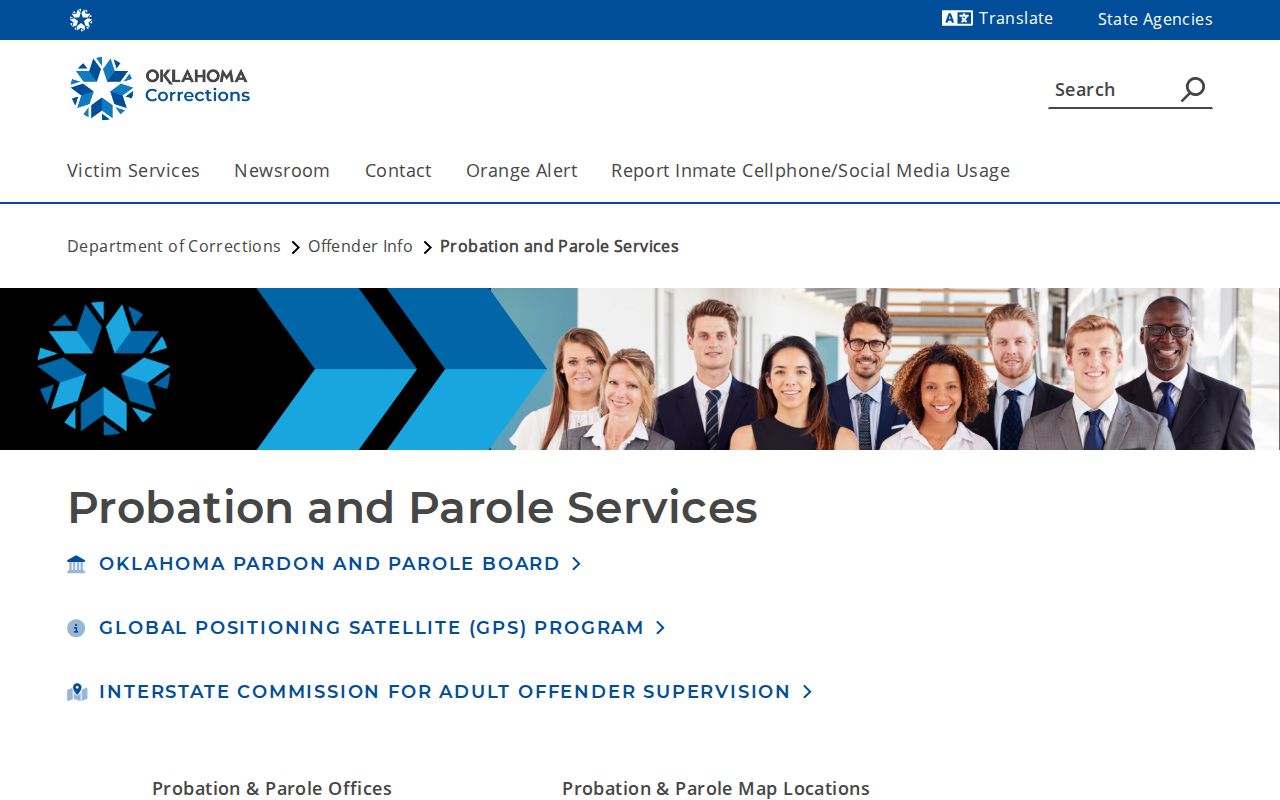
The directory image supports the office identity and contact path, while the office must still confirm the person-specific assignment.
Okmulgee Supervision Warrants and Absconders
Supervision requires compliance with the conditions in the governing court, board, and ODOC record. A violation allegation can lead to added reporting, a warrant, revocation proceedings, or a return to custody, depending on the legal process. An absconder or fugitive listing means ODOC alleges that the person failed to comply or cannot be located as required. It is not proof of a successful discharge. It also is not a final court finding on every alleged act.
ODOC provides a statewide fugitive search. No official Okmulgee-only absconder list was found. The Fugitive Warrants Division can be reached at 405-425-2570 or 405-425-2571, toll-free at 866-363-1119, or at warrants@doc.ok.gov. That unit is not a general release desk. Do not approach a person shown as wanted. Use the listed official channel for status clarification and urgent safety concerns through the proper emergency service.
A VINE alert may report a custody change, and a PPB notice may concern a hearing. Neither automatically proves that community supervision ended. Read the reporting agency and event wording, then compare ODOC’s current public status.
Note: Oklahoma’s fugitive tool is statewide, so the absence of an Okmulgee-only list does not mean warrant information is unavailable.
Okmulgee Supervision Discharge Records
Release from prison, completion of a jail booking, and discharge from supervision are separate events. A parolee can live in Okmulgee County while still serving the balance of a sentence under legal control. Probation can remain active after all physical custody has ended. Discharge is the record-backed end of the identified ODOC or court supervision relationship. Another case, registry duty, or jurisdiction can still exist, so a discharge should not be stretched beyond the term it names.
ODOC Legal Services lists Closed Records at 405-425-2691 and a discharge mailbox, osordischarges@doc.ok.gov. The ODOC Open Records Request is a route for releasable incarceration or supervision material. Use the exact ODOC number, a defined date range, and the specific record sought. Oklahoma’s Open Records Act begins at 51 O.S. §24A.1, but it does not make all information public. Confidential, sealed, medical, security-sensitive, and other protected material may be withheld or redacted.
For registry data that appear stale or wrong, the official offender-registry detail provides a “submit a note” correction route. Registry presence concerns a statutory registration record, not a general parole list. A purpose-specific correction request or ODOC discharge inquiry is more reliable than a copied commercial record.
Okmulgee Parole Board Results
The Oklahoma Pardon and Parole Board publishes monthly dockets and result files. Search both by full name and ODOC number. A docket proves that a matter was set for consideration. It does not prove approval. After the meeting, inspect the matching result and any validated material. The Board reports that three of five votes form a majority and that votes are not final until the meeting ends and results are validated and posted.
Possible actions include a nonviolent parole grant, a violent-parole recommendation to the Governor, denial, or passage to a later docket. Even a grant or recommendation does not supply the prison-gate time. Compare it with ODOC status and Sentence Administration. The PPB meeting archive adds minutes and prior materials, while current dates should be taken from the live calendar rather than copied into evergreen text.
Eligibility under 57 O.S. §332.7 varies by offense date and category. Current law describes different general thresholds for different date bands and excludes or specially treats some crimes. Eligibility is not an entitlement to parole. A recommendation is not release, and parole is not discharge.
For crimes in the date band from July 1, 1998 through October 31, 2018, the current compilation describes a general one-third threshold. For crimes on or after November 1, 2018, it generally describes one-fourth, subject to exclusions and special processes. Earlier offenses have other tests. Life without parole, certain violent crimes, and crimes governed by the 85-percent provisions can be excluded from administrative parole or follow added stages. The law in force for the offense date controls.
A clean review therefore uses three records. The docket establishes scheduled consideration. The validated result establishes what action the Board reported. ODOC status and the field office establish the current corrections relationship. If those sources differ, do not guess that one is stale. Ask PPB about its action and ODOC about present status, because each agency records a different step.
Meeting dates and locations can change. Use the current PPB calendar for timing, then retain the month and ODOC number used to find the result. Archived meeting materials can help resolve an older action, but the validated result and current ODOC record still control their own distinct questions.