
Okmulgee Projected and Actual Release
Oklahoma Department of Corrections uses the term “projected release date,” or PRD. It estimates when an ODOC term may end under current sentence data, credit class, achievements, conduct, and legal limits. ODOC also describes an actual future date as tentative and treats some precise prospective information as confidential absent a qualifying need. A displayed PRD should be quoted with its label and the date it was checked. A future PRD does not prove release will occur, and a past PRD does not prove it occurred as forecast.
County jail timing follows a different framework. An Okmulgee booking can end through bond satisfaction, a court order, dismissal, time served, sentence expiration, or transfer. A pretrial detainee has no computed ODOC sentence end. Tiger may show “Schedule Release Date,” yet a sampled record in its Released Last 72hrs feed displayed that field as N/A. OCCJA’s final record and the court order are the better sources for the actual county event.
Release can also mean transfer. A move from OCCJA to ODOC, another jail, federal custody, or immigration custody is not a return to the community. Always ask which custodian the date describes.
Find Okmulgee Projected Release Dates
Start with the custody setting. For a state prisoner, open the ODOC Offender Lookup from the agency’s offender-information hub. The live interface requires acceptance of a disclaimer and currently warns of unanticipated issues after a change in data source. Search with exact identity information. Compare ODOC number, name, age, offense, and photo before treating the result as the right person.
ODOC policy OP-030117 identifies offense, projected release date, and photo as lookup information. Public fields are abbreviated and do not provide an exact account of the sentence or time to serve. For an Okmulgee County jail booking, ask OCCJA for the final release record and check the disposing court. The Okmulgee County release search covers the county record path when no ODOC sentence exists.
- Identify whether the person is in OCCJA custody, ODOC custody, or another system.
- For ODOC, accept the disclaimer and search by the strongest identifiers available.
- Open the correct match and copy the exact projected-date label, status, and access date.
- Compare the court judgment for sentence length, concurrent or consecutive terms, and jail-time credit.
- For county custody, ask OCCJA and the correct court rather than applying the ODOC credit table.
- Contact ODOC Sentence Administration or Offender Records when exact discharge status matters.
Note: The ODOC lookup’s current data-source warning makes a second-source check especially important before relying on any projected date.
Okmulgee Release Date Credit Formula
A useful concept is: controlling sentence term, adjusted for concurrent or consecutive structure and jail-time credit, minus lawful earned and achievement credits, then constrained by statutory minimums and later legal events. It is only a concept. ODOC Sentence Administration applies the full record, including the applicable version of each law. A reader should not subtract a flat number of days from the court sentence.
Under 57 O.S. §138, one earned credit equals one day. Monthly credits depend on class and enumerated criminal-history categories. The current table provides 0, 22, 33, and 44 monthly credits across classes one through four for the prior-offense track. The other track provides 0, 22, 45, and 60. Achievement credits can add reductions. Disciplinary process can remove credits, and lawful restoration can change the total again.
Life sentences do not gain deductions that turn life into a fixed term. Section 138 also contains a county-jail nuance for qualifying achievement completed during continuous county custody pending trial, sentence, and transfer to ODOC. That narrow provision does not turn every pretrial Okmulgee stay into an ODOC class-credit calculation.
| Class | Enumerated prior track | Other track |
|---|---|---|
| 1 | 0 days monthly | 0 days monthly |
| 2 | 22 days monthly | 22 days monthly |
| 3 | 33 days monthly | 45 days monthly |
| 4 | 44 days monthly | 60 days monthly |
Why Okmulgee Release Dates Move
A PRD reflects current assumptions. Classification advancement can increase future credit earning, while a move to a lower class can reduce it. Achievement credits may shorten the calculation. A disciplinary loss can push the date later, and restoration can alter it again. Sentence corrections, amended orders, jail-time-credit changes, and the discovery of a consecutive term can also reshape the projection.
Parole creates another distinction. Board eligibility or consideration does not set the prison exit time. A docket proves only that review was scheduled. A result may show a grant, recommendation, denial, or passage, but ODOC status and sentence administration remain essential. A detainer from another authority may cause a handoff on the expected date, not community release.
| Factor | Possible effect | Confirm with |
|---|---|---|
| Credit class or achievement | Moves the forecast earlier or later | ODOC sentence and credit record |
| Discipline or restoration | Removes or restores earned credits | ODOC administrative record |
| Court correction or added term | Changes the controlling sentence | Filed court order and ODOC |
| Detainer or hold | Can cause transfer instead of community release | Holding and receiving agencies |
| Parole action | Affects eligibility or release path, not a guaranteed gate time | PPB result and ODOC status |
Note: A detainer may preserve the date one custodian releases the person while changing where that person goes next.
Confirm Okmulgee Release Dates
For a state record, read current status along with the PRD. A current facility status indicates continued custody. Parole or community supervision means the person has left prison in the ordinary sense but remains under legal control. Discharge is different and can be clarified through ODOC Legal Services. Closed Records is listed at 405-425-2691, and discharge questions can be sent to osordischarges@doc.ok.gov.
The ODOC Open Records Request can seek a releasable incarceration summary or status and discharge material. Use an exact ODOC number and date range. The Oklahoma Open Records Act begins at 51 O.S. §24A.1, but exemptions still apply. Do not request or promise confidential prospective details that the public lookup does not provide.
For a pending event, an Oklahoma VINE registration can supply an alert from a participating source. The Okmulgee County VINELink check explains how to read the reporting agency and event wording. An alert still requires confirmation, because release from the named source can mean transfer.
Okmulgee 85 Percent Release Rule
Oklahoma’s 85-percent rule is offense-specific. Under 21 O.S. §§12.1 and 13.1, people convicted of enumerated crimes cannot receive parole before serving the required share, and credits cannot cut imprisonment below that floor. It is wrong to say that all Oklahoma crimes require 85 percent. The statute compilation contains multiple effective versions, so the offense date and controlling text must be checked.
This floor works alongside the two-track earned-credit rules. Class-four credit may be 44 or 60 days per month depending on the statutory history category, yet the offense-specific minimum can still constrain the result. Achievement credits and later loss or restoration add more movement. This is why an online PRD should be treated as ODOC’s current calculation rather than rebuilt from a few public facts.
A parole eligibility rule also differs from a projected sentence date. Eligibility is the point at which consideration may occur under the applicable law. It is not a right to release, a grant, an actual exit time, or a discharge.
Okmulgee County Jail Release Dates
OCCJA operates the Okmulgee County detention facilities. The local Tiger detail can display a scheduled field, but that vendor field is not the final release record. Ask OCCJA at 315 West 8th Street, Okmulgee, OK 74447, or 918-752-0983 for the actual release date and time, authority or type, and destination if transferred. No local fee schedule, guaranteed response interval, or public records-counter hours were established, so ask for current arrangements and an estimate.
The disposing court explains legal authority. OSCN can provide the state district case trail. Okmulgee Municipal Court handles City matters while OCCJA holds the physical detention record, and tribal or federal cases follow their own court channels. A dismissal or bond order can explain why release was authorized, but OCCJA records when processing or transfer occurred.
Read Okmulgee ODOC Date Fields
ODOC’s public record is sentence-centered, unlike Tiger’s booking-centered county record. Search results use identifiers and status information, while agency policy supports offense, photo, and projected release date as public lookup information. Compare the ODOC number and photo before relying on the date. A shared name is not enough, and the research did not establish that every old or discharged record has an identical set of fields.
The successful manifest capture begins at the official ODOC search screen used to locate a released record and projected-date field.
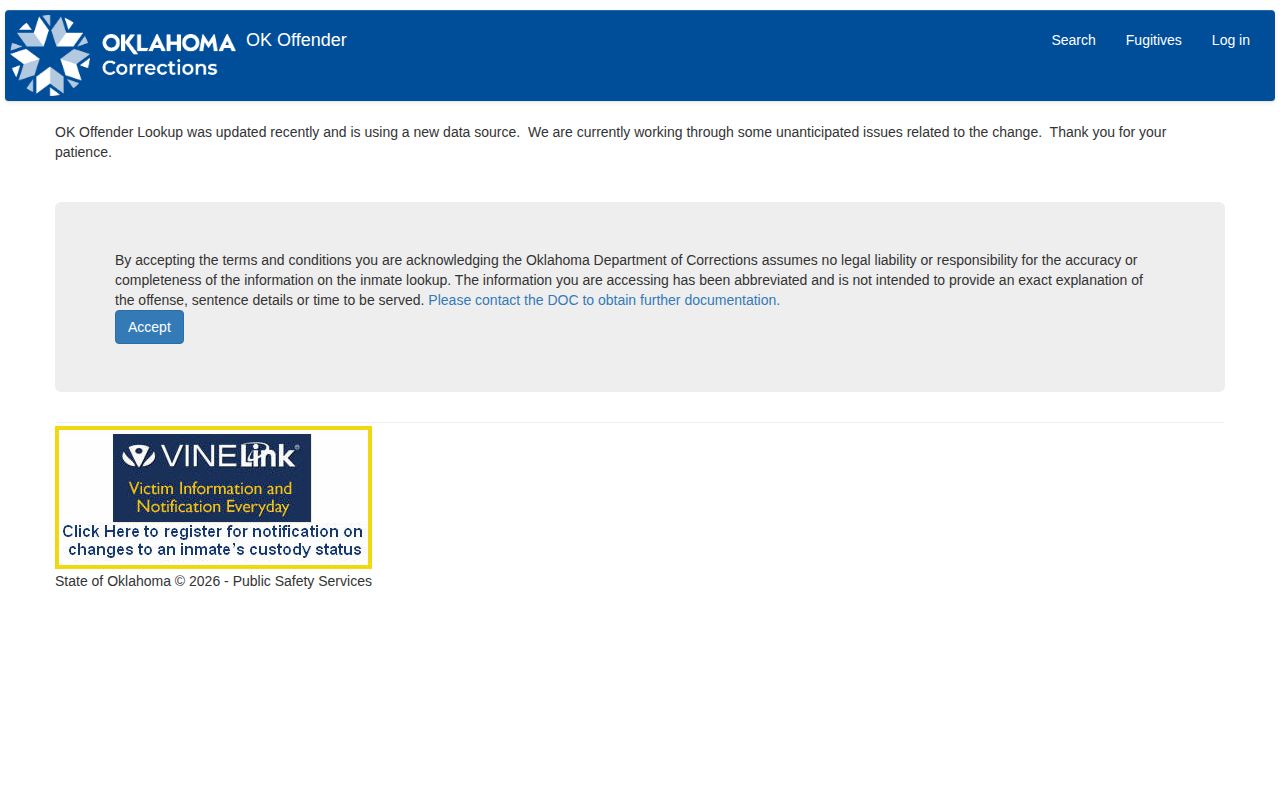
The image identifies the state search route, while the live result and disclaimer control the meaning of any current date or status.
A projected date answers when the ODOC term may end under present assumptions. It does not establish that a county charge ended, that a federal or immigration hold cleared, or that the person returned to Okmulgee County. If the displayed date has passed but the status remains unclear, use Sentence Administration, Offender Records, or the discharge mailbox rather than assuming the database simply failed to update.
Okmulgee Sentence Records Shape PRDs
The filed judgment and sentence supplies facts that a public lookup may abbreviate. Read whether terms run at the same time or one after another, whether jail-time credit was awarded, and whether a later order changed the sentence. Concurrent terms run together. Consecutive terms run in sequence. Those labels can alter the controlling term far more than a simple calendar count suggests.
For an Okmulgee state case, use OSCN to locate the docket, then obtain the filed order from the Court Clerk when shorthand is unclear. A minute entry may point to a ruling without carrying all its terms. Bond events and dismissed counts must not be folded into a prison sentence that concerns other counts. Later revocation or modification entries also can change what ODOC must administer.
Parole eligibility adds another timeline, but it is not the same date. Under 57 O.S. §332.7, eligibility depends on the offense date, category, and exclusions. Board consideration may occur without a grant, and a favorable action still does not supply the physical release time. Use the board result for its decision history and ODOC for the current sentence status.